Building a tool to quell Singaporeans' anxiety in the BTO application process
BTO Appointment Date Tracker (Unofficial)
Jul 2021 - Mar 2026
Buying a home is one of the biggest milestones in a Singaporean's life. For most, that means applying for a Build-To-Order (BTO) flat, a process that comes with long stretches of uncertainty. I created a crowdsourced tool to quell that anxiety, and in the process built a community around it.
21,766
channel subscribers
106
BTO projects covered
345,432
applicants covered
~11,000
appointment dates crowdsourced
Project
An independent initiative
Role
Founder
Contribution
Community engagement, content management, information architecture, product design, manual appointment date tracking and verification
Background
In 2019, I made my first application for a BTO flat, and found the process intimidating. Like many applicants, I relied heavily on community-run, project-specific Telegram groups to piece information together.
To reduce mental load, my husband and I built a Telegram bot to track unit take-ups for our project after we received a queue number, sparing us and our future neighbours the need to keep refreshing HDB's site manually. I later extended this initiative to other projects.
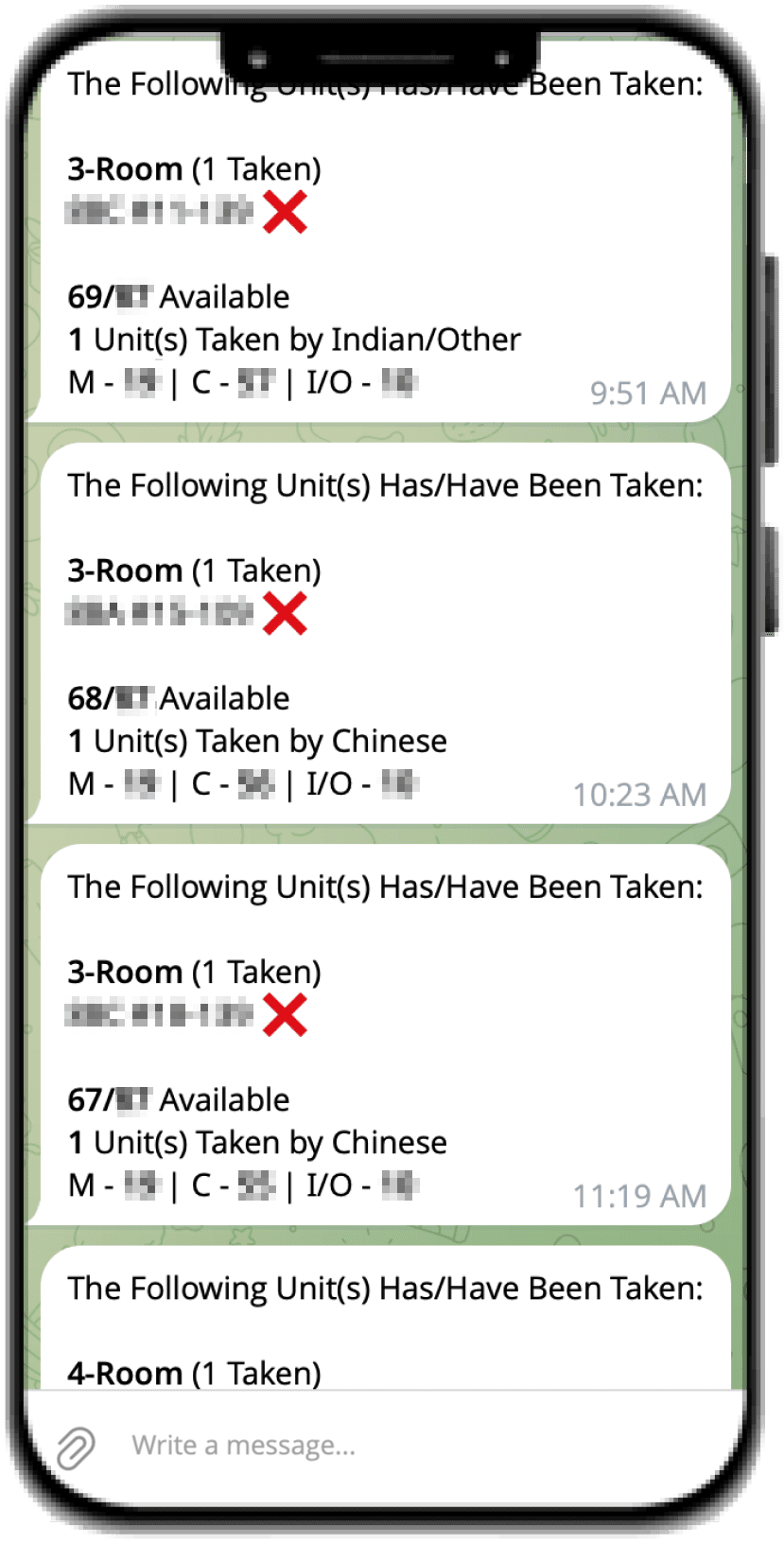

In 2021, HDB introduced Singpass verification for unit take-up data, limiting visibility to a project's own applicants. I understood HDB's likely rationale, but the change meant I could no longer continue my existing initiatives as they were. I pivoted to address a different, still-unmet need instead: visibility into appointment dates. This became BTO Appointment Date Tracker (Unofficial), a Telegram channel that I founded.
Challenge: Information gaps with real consequences
Once an applicant received a queue number, HDB would confirm only the start month of their project's selection exercise — an applicant's specific appointment date wasn't released until two weeks prior. This meant that applicants were unable to plan around a milestone that mattered: missing their selection appointment would push them down the queue, towards a narrower and less favourable set of remaining flats. For many, this uncertainty compounded the anxiety of navigating one of the biggest financial decisions of their life.

This applicant was told their project's booking exercise would start in March 2024. Their appointment ended up being in July 2024 — a gap that shows just how little the official notice actually helps with planning. (Screenshot taken from media shared in a public Telegram group)
At the same time, across the many independently-run estate group chats on Telegram, I noticed the same handful of questions resurfacing constantly — on loans, application mechanics, ethnic quota mechanics, and scheme eligibility.
Most of this information technically existed on the official HDB website, just scattered across disparate pages. Some things, though, weren't shared anywhere officially at all — like whether a given queue number was 'safe' from an ethnic quota running out. For applicants trying to plan around one of the biggest decisions of their life, that kind of clarity mattered.
North Star
Resolving to address the above challenges, I created BTO Appointment Date Tracker (Unofficial), a Telegram channel also referred to by its handle @btoapptdates.
My mission was simple:
Execution: 5 things that were crucial to my success
Availing different ways of contributing appointment dates
I availed three ways to submit an appointment date:
through an anonymous Google Form
dropping me a direct message (DM)
posting in the project's group chat
The Google Form alone logged 2,739 submissions over the course of @btoapptdates. DMs and group chat posts were never tallied, but based on my sense of the volume, they likely accounted for roughly thrice as many entries — putting the total crowdsourced dataset at around 11,000.
Meeting people where they were, then archiving for later
While a project's selection was underway, I hosted its tracker as a pinned message within that project's own Telegram group chat — the place applicants were already checking daily — so updates stayed visible without anyone needing to go elsewhere. Once a project's selection wrapped up, I migrated that tracker out of the group chat and onto the main channel, consolidating it into a permanent archive.
Live trackers stayed exactly where people needed them in the moment, while completed ones became part of a searchable reference for anyone looking up that information later.
Turning raw submissions into something usable and useful
Reconciling three disparate sources into one dataset was only half the job. I organised each tracker chronologically and grouped it by flat type (2R, 3R, 4R, and so on), since that's how applicants actually thought about their own queue position.
I also tracked when ethnic quotas ran out for each flat type, and worked out figures like "Chinese quota ran out at 123% of flat supply". This processed data gave future applicants in similarly-sized projects and/or estates a concrete benchmark to gauge their own odds against, rather than a raw data dump they'd have to interpret themselves.
Consolidating repeated answers into a single reference
Because the same questions resurfaced across dozens of separately-run estate group chats, I centralised my responses into a running set of boilerplate content on the channel's pinned FAQ — one place to update and point people toward, rather than re-explaining the same thing every time policy details shifted. This also meant the community could help each other, by forwarding directly from the channel instead of hunting down the same answer again.
Creating community
Humans are social creatures, and anxious humans don't do well in a vaccuum, even when complete information is available to them to self-help. The feeling of community was vital, which was why I made it a point to list all the Telegram groups for the different projects in my channel, which allowed it to be a wayfinding tool for people to find… people.
Outcomes
Reach across 5 years
Between its launch in August 2026 and its sunset in March 2026, the channel tracked appointment dates across 15 BTO exercises, spanning 106 projects. Those projects drew a combined 345,432 applicants — reflecting total demand across the launches covered, not everyone who necessarily knew of or engaged with the channel directly. Subscribers grew to 21,766 at peak.
A trusted reference point, not just a data source
Beyond appointment dates, the channel's pinned FAQ became a de facto knowledge base, covering recurring questions on estate group chat links, selection timelines, and where unofficial project brochures could be found. Because completed trackers were archived in a consistent, structured format — sorted by flat type, with quota benchmarks worked out for each — they kept serving as a reference point for future applicants long after a project's own selection had ended.
Trust in the channel showed up in a specific way: although I always kept an anonymous submission option open, most contributors chose to submit their appointment date updates under their own name or contact details regardless — a sign that people had come to see the channel, and me, as a reliable and safe place to contribute.
None of this was the original goal. The channel set out to solve an information problem — but the trust it built along the way turned it into a community in its own right.
Closing the channel on my own terms
I sunset the channel in March 2026, on my own initiative and timeline, rather than in response to any external pressure. Sustaining the level of care the channel had always run on was no longer compatible with my other priorities, and newer, more automatable alternatives were beginning to emerge in the same space.
My final post drew a wave of thanks from people I'd never interacted with directly, along with a number of LinkedIn connection requests from across the wider community. Several longtime collaborators — who had been running their own estate-level Telegram groups over the years — went on to launch a credited spin-off to continue the work, and other independent efforts have since emerged as well.
The closing line of that final post sums up how I felt about it:
"Some things are built to scale. Others, to serve a season."
Takeaways
Running this for five years has surfaced a few things I keep coming back to even now.
Consistency and trust matter more than the thing itself. Anyone could, in theory, compile appointment dates from scattered group chats. What made the channel useful was being reliably present for years, in a way that let people extend trust well beyond what the tool itself technically asked of them.
Working without a mandate was an advantage, not a limitation. I've come to believe that there's a category of problems better solved by someone without a formal mandate. Not being HDB meant I could speak plainly, adapt quickly, and admit uncertainty in ways an official channel couldn't — and that honesty gave me the opportunity to meaningfully connect with Singaporeans.
Knowing when to stop is its own skill. Deciding to shut this project down was, in its own way, as deliberate a decision as starting it. I didn't want the channel to fade out unexplained, and I didn't want to keep running something without the care it deserved just because it had reached a certain scale.
Something made for public good often has more impact than we realise. I don't think I fully understood this until the very end — the wave of thank-you messages, and the number of people who quietly told me their families had relied on the channel for years, without me ever knowing they were there. As a public servant, this impact is what keeps me going.